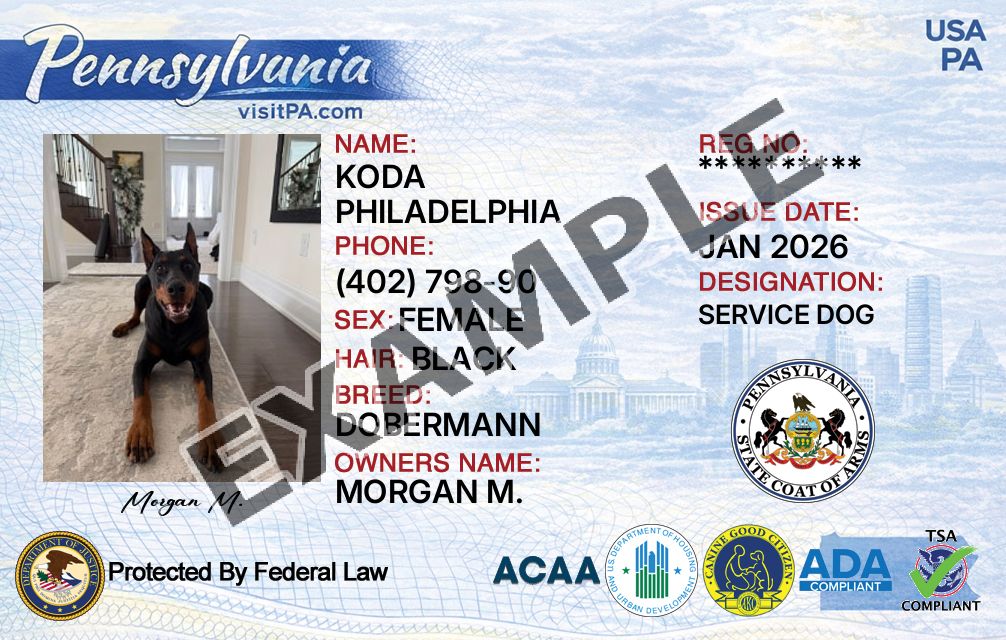
If you’re asking where do I register my dog in Pittsburgh, Pennsylvania for my service dog or emotional support dog, the key thing to know is this: most “registration” is actually a local dog licensing process, and it’s separate from service dog rights or emotional support animal (ESA) documentation.
In Pittsburgh, a dog license in Pittsburgh, Pennsylvania is typically tied to where your dog lives (city vs. outside city limits), and rabies vaccination rules come from state and public-health requirements. This page explains where to register a dog in Pittsburgh, Pennsylvania, which offices to contact, what you may need, and how service dogs and ESAs fit in legally.
Where to Register or License Your Dog in Pittsburgh, Pennsylvania
Licensing is commonly handled at the city or county level. If you live inside the City of Pittsburgh, dog licensing is handled through the City of Pittsburgh. If you live in another municipality in Allegheny County (outside Pittsburgh city limits), the county treasurer is a common starting point for licensing information and applications. For bite/rabies exposure guidance, Allegheny County Health Department resources may apply. The offices below are examples of official contacts commonly used for animal control dog license Pittsburgh questions and related rabies enforcement support.
Official offices (examples)
| Office | Address | Phone | Office Hours | |
|---|---|---|---|---|
|
City of Pittsburgh — Pet License Department (Treasurer)
Dog licensing for City of Pittsburgh residents
|
414 Grant Street Pittsburgh, PA 15219-2476 |
412-255-2575 (additional info) 412-255-2967 (lost tag) |
Not listed | Not listed |
|
City of Pittsburgh — Animal Care & Control (Animal Control Office)
Animal control contact for Pittsburgh city limits
|
City-County Building 414 Grant Street Pittsburgh, PA 15219 |
412-255-2036 (office) 412-255-2935 (emergencies; see hours) |
Not listed |
Office
Mon–Fri: 7:00 a.m. – 3:00 p.m.
Daily Operations
Mon–Fri: 7:00 a.m. – 11:00 p.m.Weekends/Holidays: 9:00 a.m. – 5:00 p.m. Emergencies
Mon–Fri: 11:00 p.m. – 7:00 a.m.Sat/Sun: after 5:00 p.m. – 9:00 a.m. |
|
Allegheny County Treasurer’s Office — Licensing Department (Dog License)
Common licensing office for Allegheny County municipalities (outside Pittsburgh city limits)
|
Allegheny County Courthouse, Room 108 436 Grant Street Pittsburgh, PA 15219 |
412-350-4100 | Not listed | Mon–Fri: 8:30 a.m. – 4:30 p.m. |
|
Allegheny County Health Department — Public Health Laboratory (Rabies Specimen Drop-off)
Rabies testing logistics and rabies consultation contacts
|
119 Commonwealth Drive Warrendale, PA 15086 |
412-578-8070 (Mon–Fri consultation line listed) 412-687-2243 (evenings/weekends/holidays consultation line listed) |
Not listed | Mon–Fri: 8:00 a.m. – 3:30 p.m. (lab hours listed) |
Note: If you are unsure whether you are within Pittsburgh city limits, confirm your municipality first. The correct licensing office can vary depending on whether your address is in the City of Pittsburgh or another Allegheny County municipality.
Overview of Dog Licensing in Pittsburgh, Pennsylvania
What “registering your dog” usually means
In everyday terms, when people ask where to register a dog in Pittsburgh, Pennsylvania, they typically mean getting a legally required dog license and tag. A dog license helps connect a found dog to the owner, supports local enforcement, and is commonly required for dogs living in the jurisdiction.
City of Pittsburgh licensing (city residents)
The City of Pittsburgh states that a license is required for every dog age three months and older living in the City of Pittsburgh. The city also indicates annual licenses are valid for the calendar year (January 1 through December 31). If your address is within city limits, you’ll generally work with the City of Pittsburgh Treasurer / Pet License Department to apply and renew.
Allegheny County licensing (outside city limits)
If you live outside Pittsburgh city limits but still in Allegheny County, dog licensing is commonly handled through the Allegheny County Treasurer’s Office (Licensing Department) and other official county licensing channels. The county treasurer’s licensing information also notes that all dogs three months or older must be licensed by January 1 each year, with annual licenses running January 1 through December 31.
Why animal control may come up in licensing questions
People often connect licensing with animal control because local animal control is the group most likely to respond to issues like stray dogs, bite incidents, or dogs running at large. In Pittsburgh city limits, the City’s Animal Care & Control contact information is a practical resource for animal control dog license Pittsburgh questions—especially if your dog was picked up, you lost a tag, or you need to confirm local requirements.
How Dog Licensing Works Locally in Pittsburgh, Pennsylvania
Step 1: Confirm whether you live in the City of Pittsburgh or another municipality
This is the step that most often causes confusion. Pittsburgh has its own city licensing instructions for city residents, while county licensing resources apply broadly across Allegheny County for people outside the city. If you’re unsure, start by confirming whether your address is within City of Pittsburgh boundaries (not just “Pittsburgh” in a mailing address).
Step 2: Get your dog’s rabies vaccination up to date
Pennsylvania guidance indicates that dogs and cats are required to have current rabies vaccination (and state guidance also describes rabies vaccine timing and re-vaccination schedules). Keep documentation from your veterinarian. Rabies compliance is important not only for licensing, but also for bite/exposure situations and public health follow-up.
Step 3: Complete the correct license application and pay the fee
The City of Pittsburgh outlines a process that involves getting the dog license application, completing it, and mailing it with payment to the city’s pet license department (payable to the Treasurer, City of Pittsburgh). The City also lists different fees based on whether the dog is spayed/neutered and offers multi-year terms.
Step 4: Keep the tag accessible (and replace it if lost)
A license is only useful if it can be connected back to you. Keep the tag on your dog when appropriate. If your tag is lost, follow the relevant office’s replacement instructions (the City of Pittsburgh provides a phone number for lost tags).
Step 5: Know who to call for animal control vs. licensing questions
In Pittsburgh, you may end up contacting different offices depending on the problem you’re trying to solve:
- Licensing and tags: city pet license department (city residents) or the county treasurer’s licensing department (many non-city municipalities).
- Loose/stray/dangerous dog complaints: local animal control (Pittsburgh Animal Care & Control for city limits).
- Rabies exposure guidance/testing logistics: Allegheny County Health Department resources may be involved, especially after bites or exposures.
Service Dog Laws in Pittsburgh, Pennsylvania
A service dog is defined by training and disability-related work
A service dog is generally understood as a dog individually trained to do work or perform tasks for a person with a disability. The critical point for most “registration” questions: you do not create service-dog legal status by buying a certificate, vest, or online registration. The dog’s role and training are what matter.
A dog license is still a local requirement
Even if your dog is a service dog, the local dog licensing rules can still apply. That means a service dog can still need a standard dog license in Pittsburgh, Pennsylvania, along with current rabies vaccination, just like other dogs living in the city.
Public access vs. licensing are separate issues
Public access rights and accommodation rules focus on disability access and behavior standards in public settings. Licensing focuses on local identification and compliance. If someone asks where do I register my dog in Pittsburgh, Pennsylvania for my service dog, the most accurate answer is usually: license your dog through the local office that covers your home address, and keep your training documentation/records for your own needs (not as a “license”).
Emotional Support Animal Rules in Pittsburgh, Pennsylvania
An ESA is not the same as a service dog
Emotional support animals provide comfort by their presence, but they are not the same as service dogs trained to perform specific disability-related tasks. Because of that, ESAs generally do not have the same public access expectations as service dogs.
“ESA registration” is usually not a government licensing process
When people say “register my emotional support dog,” they’re often looking for a way to document their need for an ESA (commonly for housing situations). That documentation is not the same as local dog licensing, and it is usually not handled by Pittsburgh Animal Care & Control or the City/County treasurer’s licensing offices.
Your ESA still typically needs local licensing and rabies compliance
Even if your dog is an emotional support animal, local rules about licensing and rabies vaccination can still apply. So the practical approach is: complete your local dog license first (city or county as appropriate), keep rabies vaccination proof current, and then separately handle any housing documentation you may need for an ESA.